Sunday, 27 January 2013

A New Lining

Over the weekend I have been working on a waistcoat lining. The design is not quite finished, but the drawing is, so I have posted it below. As you can see I have gone for a Mughal style composition squashed into the form of a Paisley pattern. So far so good, but if you look closer you will see that I have subverted it with all sorts of computer cables, satellite dishes and -perhaps too obviously- an ipad. What I am trying to get across is rather contradictory: The story behind the wool I use and the imagery in my linings and labels, focuses on a romantic ideal of the Hindu Kush: high mountains, rugged hospitable people and timeless, pre industrial crafts. All this is true, but I am only able to bring it together and sell it to a Western market because of communications technology. People in Chitral may lead lives steeped in tradition, but they also text and tweet and send facebook messages, that's how I can do business with them from the other side of the world.


With some colour added...


Friday, 11 January 2013

Details of Jackets

I have just taken these detail shots of jackets 1 and 2.

Jacket 1

Jacket 2

Wednesday, 9 January 2013

Collar Styles

Last weekend I took these photos of the collar styles of jackets one and two.


Jacket One


Jacket 2


Saturday, 5 January 2013

Tirich Mir

At 7,708 meters Tirich Mir is the highest mountain in the Hindu Kush range, the highest mountain outside the Himalayan-Karakoram range and the 33rd highest mountain in the world. In my previous post I explained how our wool is made at its feet.

Independent of its height Tirich Mir is remarkable for lots of different reasons. Firstly it dominates the Chitral valley in the most awe-inspiring way. As you fly into the tiny Chitral airport Tirch Mir floats high above the aircraft, a blinding-white chunk of land, which seems out of place so deep into the sky. Once on the ground the mountain is inescapable, a constant presence, far to the West, but appearing deceptively close due to its scale and brilliance.

The human story of Tirich Mir is beguiling too: first climbed in 1950 by the Norwegian mountaineer turned eco-philosopher Arne Naess, the mountain has played its part in the environmental movement of the twentieth century. Before Naess people in Chitral had imagined presences on summit of Tirich Mir, djinns (demons) were said to haunt its slopes. More profoundly though, the summit was understood to be the meeting place of mountain top fairies. These fairies played and still play an important role in the pre-Islamic religions of the region, guarding the purest places, beyond the polluting reach of man.


Tirich Mir from theworldmountain.blogspot.co.uk


Tirich Mir looming over Chitral valley. From Zerega at www.panoramio.com.


Tirich Mir from Shahi Masjid in Chitral town. 


Friday, 4 January 2013


A Woodcut of Tirich Mir

The wool for our garments is spun in the shadow of Tirich Mir, the Highest mountain in the Hindu Kush. It is washed in streams fed by the mountain's glaciers and the sheep which provide it graze the mountain's foot hills. Therefore I thought it was important that an image of Tirich Mir was somehow incorporated into our first collection, so I engraved a woodcut of the mountain as seen from the south. The woodcut was then printed onto paper using the burnish technique and finally digitally printed onto cotton. The printed cotton image will be sewn onto the inside of the second jacket in the collection.


The wood cut in progress: I used an engraving tool and a knife brought in Chitral, North West Pakistan.


The wood block after being inked.


Printed onto fabric.

Sunday, 16 December 2012

Kalasha Style

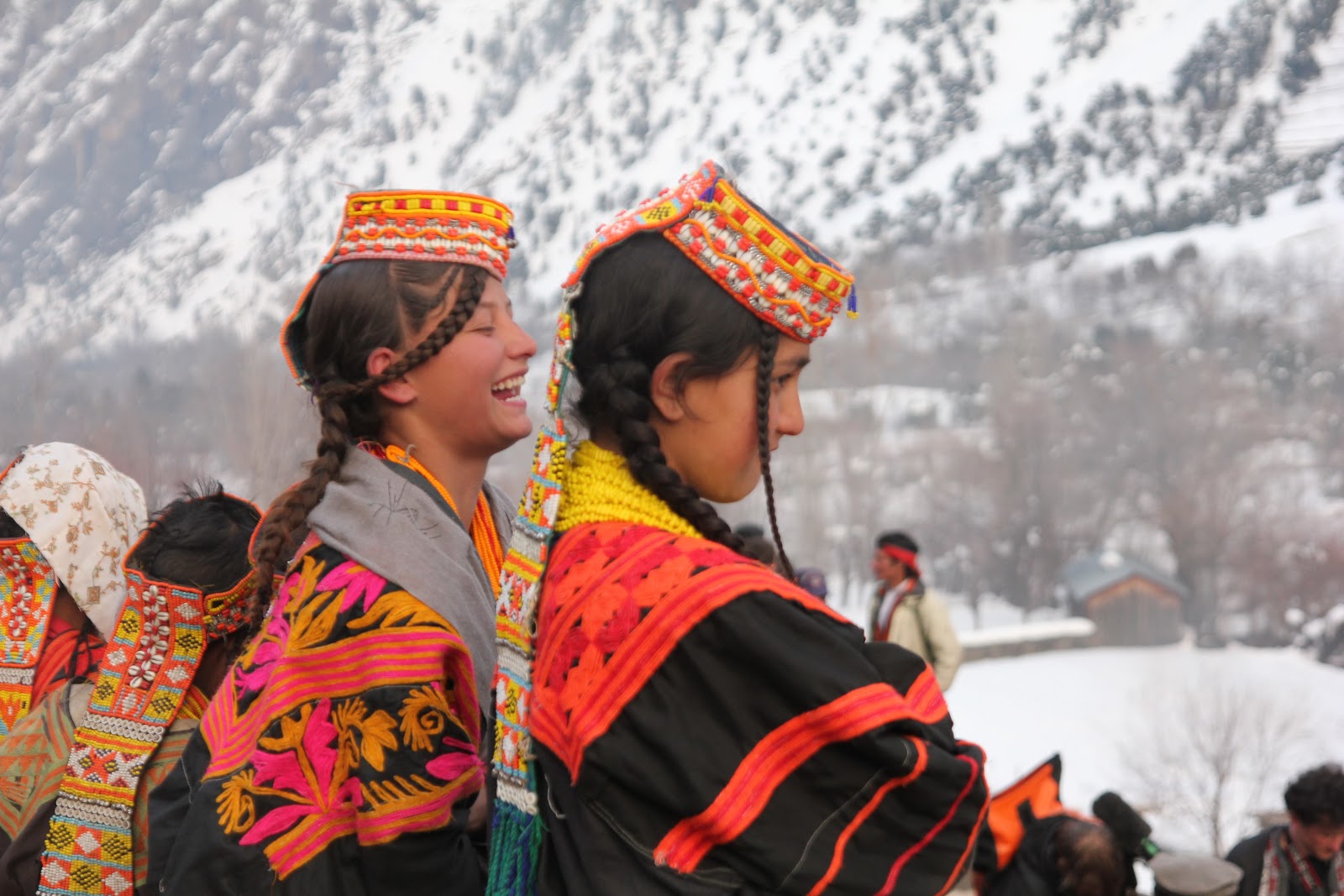
The most iconic garments from Chitral are the heavily embroidered dresses of Kalasha women. The Kalasha are a minority within Chitral, non Muslims who live in three small valleys on the border with Afghanistan. Their religion which includes elements of animism and polytheism, but which acknowledges one god, was once practiced across the Hindu Kush, but now is limited to 3,000 or so adherents.

The Kalasha's unique religion, their beautiful valleys, their distinctive costume and certain practices like wine making and solstice festivals have long made them popular with scholars and more recently; tourists. Throughout Pakistan and abroad the Kalasha have come to be symbolised by the striking dresses worn by their women. These dresses start off life as a baggy black cotton shirt, which is then personalised with bright wool embroidery around the hems and collar. Interestingly these dresses are a recent innovation. Traditionally Kalasha women wore brown-black homespun woolen dresses, globalization and the introduction of a monetary economy to the region have provided women with access to cheap cotton and dyed wool from China. Ironically enough it is the availability of mass produced products which has given Kalasha women a new means to express their individuality.

The photos below are of our friends or their relatives in Kraka village (2011).


Photos reproduced with kind permission of Matan Rochlitz.

Dressing Up in British India

Side stepping the fraught issues of imperialism, it has to be said that British India did produce some remarkable outfits. Chitral, where our wool comes from lay on the North West frontier the Empire, a region where British rule was indirect and the uniforms of the soldiers who served there tended to reflect this. The corps of guides was the first unit recruited from this region and its uniforms echoed the traditional dress of the area. Most significantly the Corps of Guides was the first unit of the British army to reject bright red tunics and instead camouflage their uniforms with a local dye called khaki (a Persian word meaning 'soil coloured'- خاکی).

The images below show from top: Major Dighton Probyn VC, one of most renown dresser uppers of mid nineteenth century India. Dighton Probyn founded Probyn's Horse and the second row shows two officers from that unit, from around the turn of the twentieth century. The next row is of officers from Hodson's Horse, which would later become the Corps of Guides mentioned above. Note the wonderfully louche pose of the officer in the middle. The final image is of Captain Colin Mackenzie who had many an adventure on the frontier and here is depicted in Afghan dress, note the ikat hem on his coat.